Shopify Internal Linking: Beyond the Loop – Making Every Click Count
Hey everyone! Your friendly ecommerce ops expert here, ready to dive into a topic that often sparks a lot of head-scratching in the SEO community: internal linking. Specifically, how do you tell the difference between a genuinely helpful internal link and one that just creates a 'circular' path that might not be doing you any favors?
This came up recently in a great discussion I saw online, where the original poster asked exactly this: "When evaluating internal links, how do you distinguish between a link that creates an unhelpful circular path and one that simply connects two closely related posts?" They also wondered if Google and other crawlers even care about this level of detail or if relevance, anchor text, and site structure are more important.
It's a fantastic question, and one that every Shopify merchant and store operator should be thinking about. Let's unpack the insights from the community and give you some actionable takeaways for your store.
The Myth of the 'Bad' Circular Link
One of the clearest themes from the discussion was a collective sigh of relief about so-called 'circular' links. As one insightful community member put it, "A cycle is not a problem by itself. A to B and back is useful when the pages serve different intents and the links help readers move between them." Another added, "A → B → A isn’t inherently bad. Websites are graphs, not one-way funnels."
This is a crucial mindset shift. The goal isn't to meticulously avoid any back-and-forth linking. Instead, it's about the utility of that link for both the user and the search engine crawler. Crawlers are smart; they deduplicate visited URLs and won't get 'trapped' in a loop. What they do care about is understanding your site's content, its hierarchy, and how different pieces of content relate to each other.
What Makes an Internal Link Truly Valuable?
The consensus boiled down to a simple rule: If the reciprocal link makes the relationship between two pages clearer for the user and the site, keep it. If it only exists to manufacture relevance, remove it.
Here’s a breakdown of what makes internal links valuable, drawing from the expert advice shared:
- User Journey & Intent: Would a user on Page A reasonably need or want to go to Page B next? Think about your customer's journey. If they're on a product page for a specific coffee blend, linking to a blog post about brewing methods for that blend, and then back from the blog post to the product page (perhaps to buy accessories mentioned), is incredibly helpful.
- Clear Anchor Text: Does the anchor text (the clickable words) clearly describe what Page B is about? Generic anchors like "click here" are a missed opportunity. Be descriptive and relevant.
- Discovery & Crawlability: Does the link help search engines discover important pages or improve their crawl path? Good internal linking ensures that no important page is an orphan, making it easier for Google to find and index your content.
- Context & Relationship: Does the link clarify a parent/child, sibling, or topical relationship between pages? For example, a collection page linking to a specific product, and that product page linking back to its parent collection, helps reinforce the hierarchy. Or, two related service pages linking to each other because users commonly need both – that's useful information architecture, not a harmful loop.
- Conversion Path: Does the link support a conversion goal? Directing users from a blog post about skincare routines to relevant product pages is a prime example.
Actionable Steps for Your Shopify Store:
To evaluate your own internal links, particularly reciprocal ones, a community member suggested a great framework. You can adapt this for your Shopify store:
- Map Your Links: If possible, export a list of your internal links (source page, target page, anchor text, and link location – e.g., body content, navigation, footer). Focus on links within your main content for this exercise, rather than boilerplate navigation.
- Review Reciprocal Links: Identify pairs of pages that link to each other. For each pair (let's say Page A and Page B):
- Ask: Would someone on Page A reasonably need Page B next?
- Ask: Does the anchor text describe Page B clearly and accurately?
- Ask: If you remove this specific link, does the discovery, click depth (how many clicks from the homepage), or overall context for the user get worse?
- Optimize or Remove: If your answers are mostly 'no' to the user need, 'no' to clear anchor text, and 'no' to worsening discovery/context, then that link might be boilerplate noise. Consider removing it or re-evaluating its purpose. If the answers are 'yes', keep it!
Remember, Google explicitly states that links help it discover pages and judge relevance. Descriptive anchors and ensuring every important page has an internal link are key signals that matter more than obsessing over avoiding reciprocal links.
EShopSet Team Comment
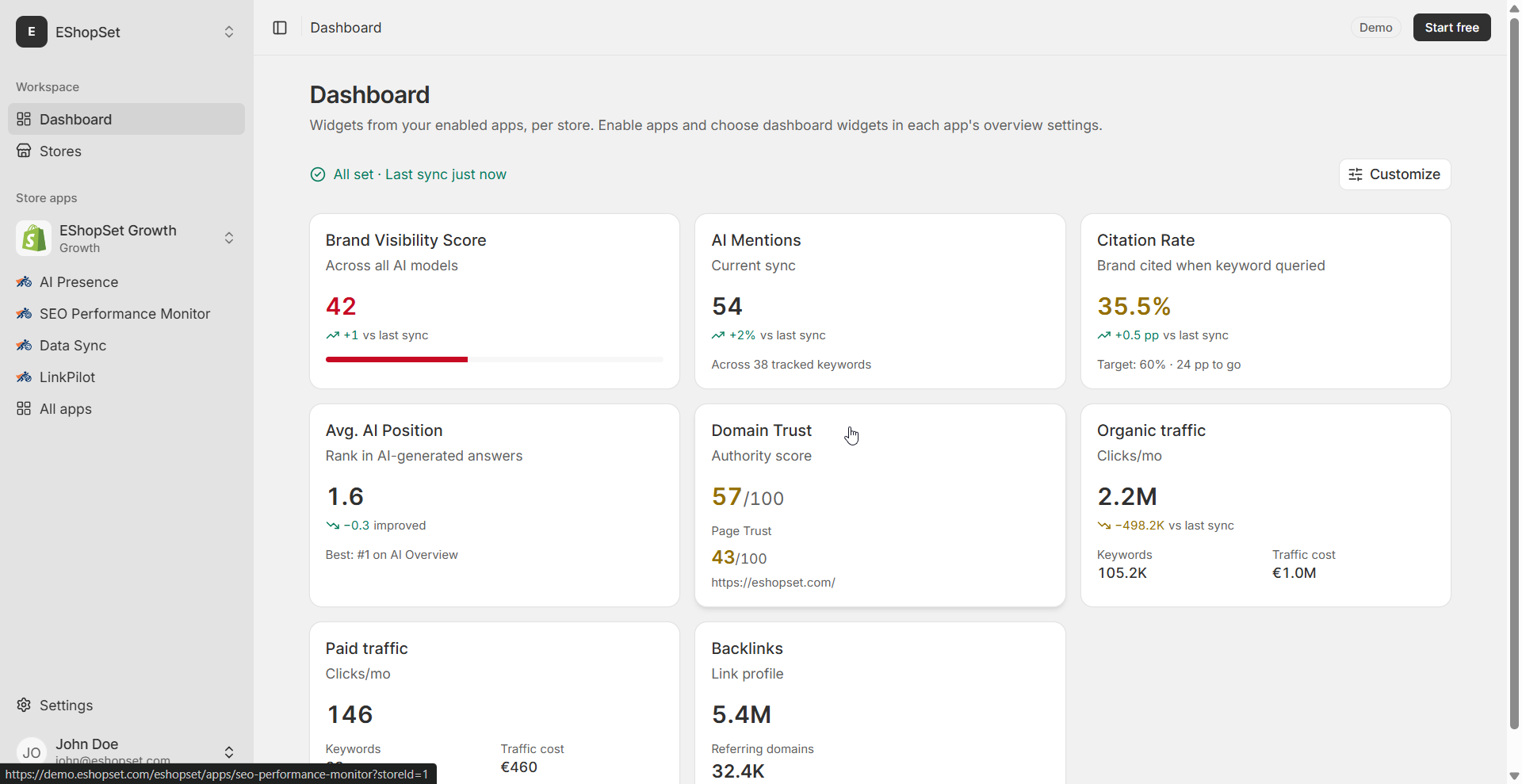
We completely agree with the community's insights: internal linking is about utility, not just avoiding 'loops.' For Shopify merchants, a robust internal linking strategy is fundamental to strong SEO. Our SEO Performance Monitor app is invaluable here, helping you track crawlability, identify orphan pages, and ensure your most important content is easily discoverable by search engines. Furthermore, a well-linked site with clear relationships between pages directly aids Shopify AI Presence, as it helps AI models better understand your content's context and relevance, improving your visibility in AI-driven search results and brand citations.
Beyond Circularity: Focus on Site Structure and User Experience
Ultimately, the conversation reinforced that worrying about "circular internal linking" in isolation is often a distraction. Your focus should be much broader: on overall site structure, clear crawl paths, descriptive anchor texts, and ensuring all your important pages are genuinely connected in a logical and helpful way. This is where your efforts will yield the biggest SEO gains for your Shopify store.
Think about how you can use internal links to create a rich, interconnected web of content that guides both users and crawlers seamlessly through your store. This not only boosts your SEO performance but also enhances the overall shopping experience, leading to happier customers and better conversions. And that, my friends, is a win-win in the world of ecommerce!