Beyond Citations: Actionable AI & Voice SEO Metrics for Shopify Merchants
Hey there, fellow Shopify store owners and operators! Let’s be honest, navigating the world of SEO, especially with the rise of AI Overviews (AIO) and voice search (VSO), can feel like trying to hit a moving target. Many tools give us high-level insights, but when it comes to truly understanding how our brand shows up in these new search landscapes, it often boils down to a simple "were we cited or not?"
Recently, a fantastic discussion popped up in an expert community, diving deep into this exact challenge. The original poster highlighted how this broad "citation" metric feels too shallow for real SEO strategy. And you know what? We couldn't agree more. For Shopify merchants aiming to boost their Shopify organic keyword rankings and truly stand out, we need more granular, actionable data.
Moving Beyond Simple Mentions: What Really Matters
The original poster laid out several crucial metrics that go way beyond a simple brand mention. Let’s break them down and see how they apply to your Shopify store:
- Prompt Intent Coverage: Are you showing up for different types of search queries? Think about "informational" (e.g., "best way to clean leather boots"), "category" (e.g., "vegan leather boots"), "comparison" (e.g., "brand X vs. brand Y boots"), or "vendor-selection" (e.g., "where to buy waterproof boots online"). Your content strategy needs to cover all these bases.
- Recommendation Share: It’s one thing to be mentioned; it’s another to be *recommended*. When a prompt has commercial intent (someone looking to buy), is your Shopify store, product, or brand explicitly suggested as a solution? This is gold.
- Framing: How is your brand described? "Affordable," "premium," "eco-friendly," "innovative"? The attributes associated with your brand in AI answers significantly influence perception and click-through rates.
- Source Dependency: Which pages or sites seem to influence the AI's answer about your brand? Is it your product pages, blog posts, review sites, or perhaps a third-party comparison? Knowing this helps you optimize those influential sources.
- Stability: Is the AI's answer about your brand consistent over time and repeated queries? If it fluctuates wildly, it might not be worth optimizing for that specific phrasing or context yet.
- Gap Mapping: If you’re *not* being recommended, where’s the breakdown? Is it an issue with how clear your entity (product, brand) is, a lack of "proof" (reviews, testimonials), poor page structure, low authority, or perhaps a positioning issue in your messaging?
Adding Sentiment and Actionable Insights
A community member chimed in with another crucial point: sentiment and accuracy. It's not just *what* attributes are associated with your brand, but whether those attributes are factually correct and positive. Imagine an AI overview stating you have outdated features or incorrect pricing – that's a different kind of problem requiring a swift fix, beyond just positioning.
Perhaps the most transformative insight came from another respondent, who suggested dropping the "brand as the unit of measurement." Instead of asking "was my brand cited?" they focus on "which specific claims came back?" For example, did the sentence you wrote about your product’s unique waterproofing technology show up, even if paraphrased, in the AI’s answer?
This subtle shift is powerful because it ties directly to actionable tasks. If a specific claim about your product isn't appearing, you can investigate: Is it clearly stated on a single page? Is it using the right vocabulary for the prompt? Is it contradicted elsewhere on your site? These are concrete fixes that move the needle, rather than just admiring a "cited yes/no" metric.
Making It Actionable for Your Shopify Store
So, how do you take these expert insights and apply them to your daily Shopify operations to improve your Shopify organic keyword rankings in the AI era?
- Map Your Key Claims: For each product or service, identify 3-5 unique, compelling claims (e.g., "our product uses sustainably sourced organic cotton," "guaranteed 2-day shipping," "best-in-class customer support").
- Optimize for Clarity and Consistency: Ensure these claims are clearly stated on relevant product pages, FAQs, and blog posts. Use consistent terminology.
- Monitor AI Overviews & Voice Search: Actively search for your brand and products using various prompt intents. Pay attention to how you're framed, whether you're recommended, and if your key claims are surfacing.
- Address Gaps & Inaccuracies: If a claim isn't appearing, refine your content. If an AI answer is inaccurate, update the source material (your website, schema, press releases) that the AI might be pulling from.
- Track Performance Beyond Traffic: While traffic and conversions are ultimate goals, track the visibility of your specific claims and the sentiment around your brand in AI answers. This provides a leading indicator of future success.
EShopSet Team Comment
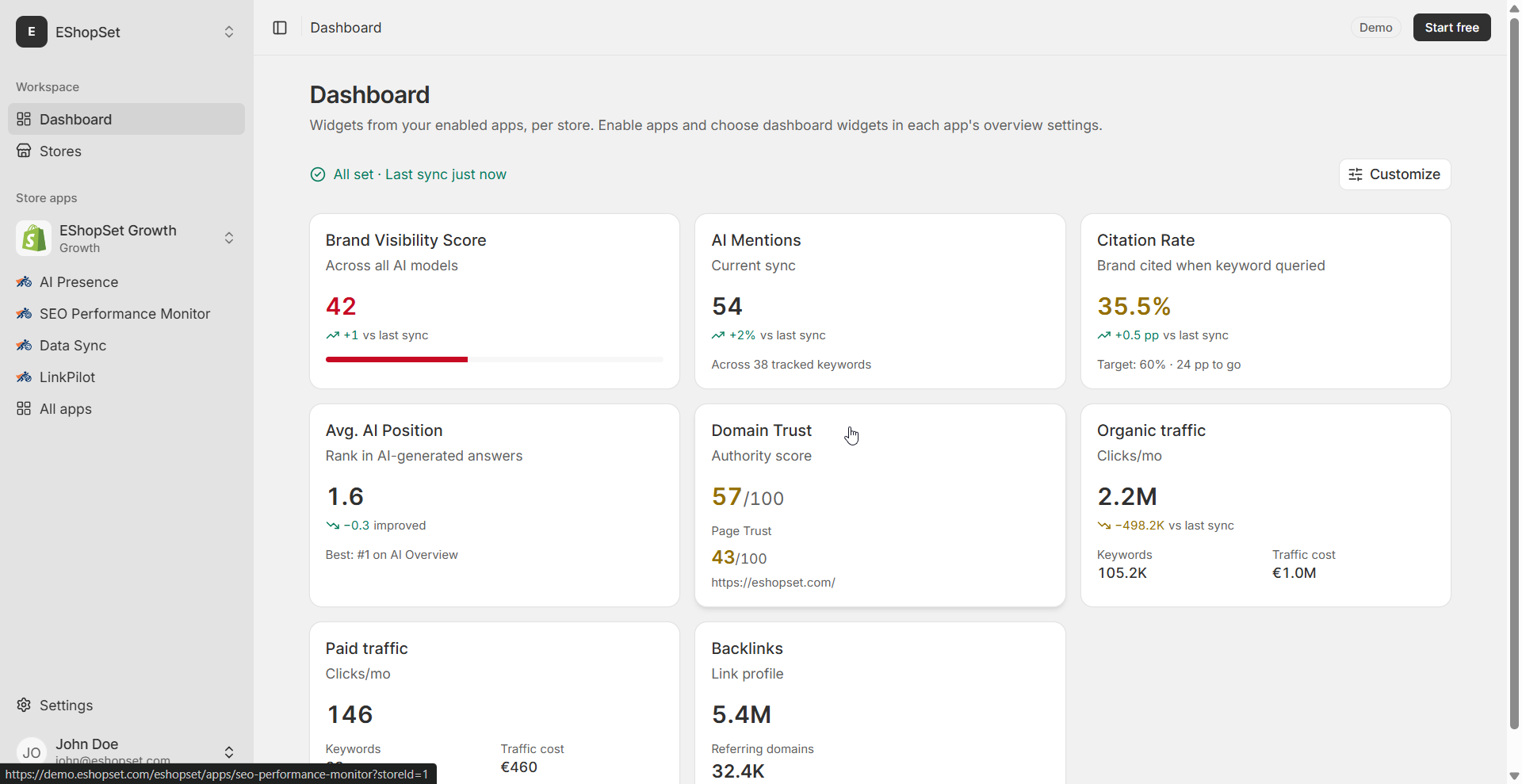
This discussion perfectly encapsulates the shift from traditional SEO to a more nuanced understanding of online presence. We strongly agree that focusing on specific claims and their accurate portrayal in AI answers is the real game-changer for Shopify merchants. Our AI Presence app is built precisely for this, helping you monitor how your brand is framed and recommended across AI-driven search. Meanwhile, SEO Performance Monitor ensures your foundational SEO is robust, tracking your Shopify organic keyword rankings and identifying opportunities to strengthen the content that feeds these AI systems. And for quickly updating product details that form those crucial claims, Sheet2Cart is your go-to for efficient catalog management.
The days of simply ranking for a keyword are evolving. Now, it's about being recommended, accurately framed, and having your unique value propositions clearly articulated by AI systems. By adopting a more granular, claims-based approach, you're not just optimizing for algorithms; you're optimizing for genuine customer understanding and trust. It’s about building a robust, resilient online presence that truly converts browsers into buyers.