Banishing Phantom Data: How to Clean Up Lingering WooCommerce Attributes and Ensure Clean Exports
Ever felt like your ecommerce store has a mind of its own, particularly when it comes to data that just won't disappear? You're not alone. We recently saw a fantastic discussion in the community that perfectly illustrates this common frustration: deleted WooCommerce local attributes stubbornly reappearing in product exports.
It's a scenario many store owners running on platforms like Shopify, Magento, BigCommerce, Wix, or PrestaShop can relate to – you clean something up, only for it to resurface like a digital ghost. This isn't just a minor annoyance; it can lead to inaccurate product data, messy integrations, and wasted time. Let's dive into what happened, why it happens, and how you can finally banish these phantom attributes from your WooCommerce exports and maintain pristine data across your entire ecommerce ecosystem.
The Mystery of the Lingering Attributes
The original poster shared a classic problem: they had deleted product-specific (local) attributes from their WooCommerce products. They'd gone through all the usual troubleshooting steps:
- Clearing caches
- Reinstalling export plugins
- Regenerating data tables
- Re-saving products
Yet, these attributes, which no longer appeared on the product edit page, continued to haunt their exports, specifically with tools like WebToffee. The core question was, "Where does WooCommerce store local attributes in the database, and how can I permanently remove these old/orphaned attributes?"
Unpacking WooCommerce's Database Secrets: Where Attributes Hide
As one insightful community member pointed out, the reason traditional troubleshooting didn't work lies in how WooCommerce handles local attributes. Unlike global attributes, which live in taxonomy tables, local attributes are stored in the wp_postmeta table.
Specifically, they reside under the meta_key called _product_attributes. What's crucial here is that all local attributes for a single product are stored together as a serialized PHP array within one database entry. Think of it as a single, complex blob of data. This means that when you "delete" an attribute from a product via the WordPress admin, you're modifying this serialized array, but sometimes, remnants can persist or be overlooked, especially if not all affected products are explicitly re-saved.
The community member further explained that common actions like regenerating lookup tables only rebuild wc_product_meta_lookup and don't touch _product_attributes. Re-saving only affects products you actively open and save, and cache clearing or plugin reinstalls don't modify stored meta data at all.
The "Straggler" Effect: Why Exports Get Polluted
The problem is compounded because export tools often build their column set from the union of every attribute found across all scanned products, including drafts and items in the trash. This means if even a handful of products – perhaps old drafts, trashed items, or simply products you haven't manually re-saved – still carry the orphaned attribute, the export tool will include that column in your entire file. Furthermore, some export plugins, like WebToffee, can save column mappings in their templates, remembering columns even if the underlying data is mostly gone.
Actionable Solutions for WooCommerce Store Owners
To truly banish these phantom attributes, you need to go directly to the source:
-
Backup Your Database: This is non-negotiable. Before making any direct database changes, always perform a full backup of your WooCommerce database. Mistakes can be costly.
-
Identify the Stragglers: Use a tool like phpMyAdmin or a database management plugin to run a read-only SQL query to find products still containing the attribute. Replace
'yourattr'with the name of the attribute you're trying to remove:SELECT post_id, meta_value FROM wp_postmeta WHERE meta_key = '_product_attributes' AND meta_value LIKE '%yourattr%';This will show you the
post_idof products that still have the attribute within their serialized_product_attributesblob. -
Carefully Edit the Data: Do NOT simply delete rows from
wp_postmetabased on the query above, as this would wipe out ALL local attributes for those products. Instead, for each identified product:- Retrieve the serialized string from the
meta_value. - Deserialize it (you might need a PHP script or a specialized database tool for this).
- Remove the specific orphaned attribute entry from the resulting array.
- Reserialize the array.
- Update the
_product_attributesmeta_valuefor thatpost_idwith the new, cleaned serialized string.
This is a delicate process and requires a strong understanding of database operations and PHP serialization. If you're unsure, consult a developer.
- Retrieve the serialized string from the
-
Check Export Plugin Mappings: Review your export plugin's saved templates or column mappings. Ensure that the orphaned attribute isn't hardcoded into any export profiles.
Beyond WooCommerce: Broader Implications for Ecommerce Data Hygiene
While this specific scenario focused on WooCommerce, the underlying principle of data integrity and the challenges of managing persistent data are universal across all ecommerce platforms. Whether you're on Shopify, Magento, BigCommerce, Wix, or managing a robust PrestaShop store, maintaining a clean database is paramount.
Consider these best practices:
-
Regular Data Audits: Periodically review your product data, attributes, and taxonomies. Remove unused or redundant entries. This is especially important when you're using advanced tools like those for PrestaShop AI product descriptions, which rely on accurate and clean attribute data to generate compelling content.
-
Leverage Staging Environments: Before making significant changes to your product catalog or installing new plugins, test them on a clone ecommerce store staging environment. This allows you to identify and fix data inconsistencies without impacting your live store or customer experience. EShopSet provides tools that can help manage your store environments and configurations seamlessly.
-
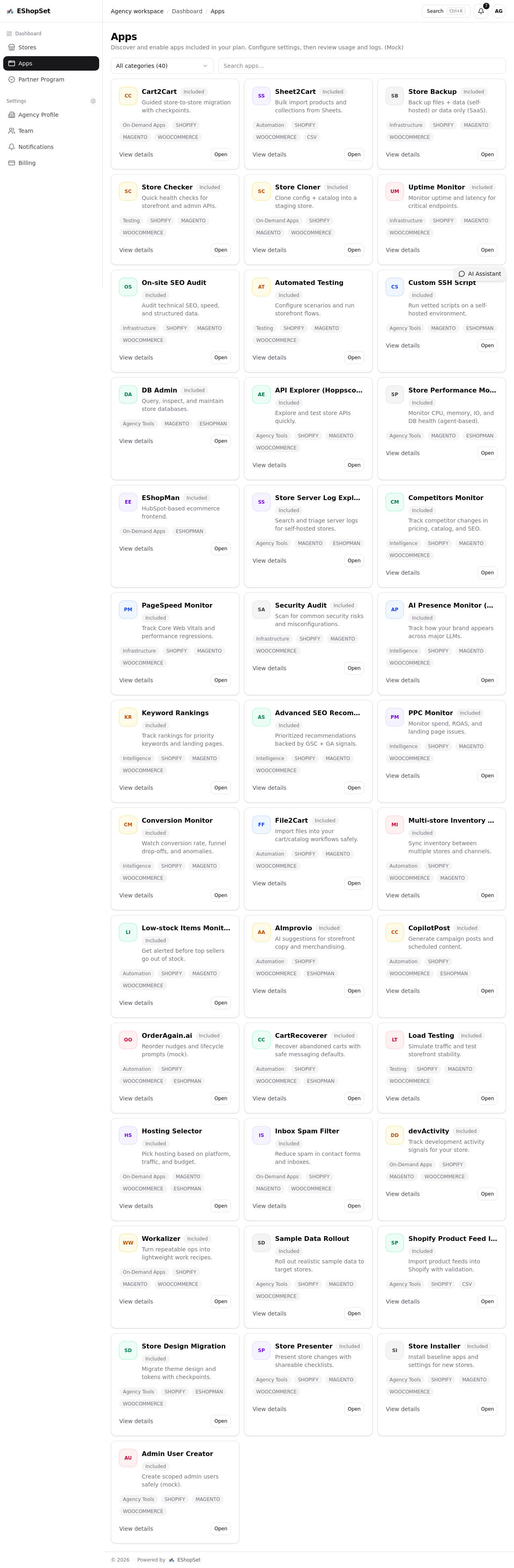
Understand Your Integrations: Every app and integration you add to your store interacts with your data. Understand how they store and retrieve information. EShopSet's apps-first commerce operations bundle helps you discover, enable, and configure apps per store, giving you a centralized view of how your various tools are impacting your data.
-
Monitor Usage and Logs: EShopSet allows you to track Usage and Logs for all your enabled apps. This visibility can be invaluable in identifying when and how data might be getting altered or orphaned, helping you debug issues before they escalate.
The complexity of modern ecommerce operations means that data inconsistencies can arise from many sources – from plugin conflicts to incomplete deletions. Proactive data hygiene isn't just about cleaning up messes; it's about building a resilient, efficient, and accurate store foundation.
EShopSet: Your Partner in Clean Commerce Operations
At EShopSet, we understand the intricate dance of data that powers your online store. Our platform is designed to simplify the management of your commerce operations, from discovering essential apps in our marketplace to configuring their settings and monitoring their impact. By providing a unified control center for your apps and data, EShopSet helps you maintain the data integrity crucial for smooth operations, clean exports, and ultimately, a thriving business.
Don't let phantom attributes or orphaned data hold your store back. Embrace proactive data management and leverage platforms like EShopSet to keep your ecommerce operations running flawlessly.