Beyond the Spreadsheet: Conquering Product Data & Inventory Sync Across Your Stores
Hey there, fellow store owners and ops pros!
I was lurking in an online community recently, and a familiar topic popped up that I just had to share some thoughts on. While the original post itself got pulled for some policy reasons, the underlying challenge it touched on is one almost every growing merchant faces: wrangling product data and keeping inventory perfectly synced across multiple storefronts.
It’s a headache, right? Whether you’re running a Shopify store alongside a WooCommerce presence, or you’ve branched out from Magento to BigCommerce, the moment you add a second sales channel, things get complicated. Fast. The initial excitement of expansion can quickly turn into a daily grind of manual updates, double-checking, and the inevitable "oops, that was out of stock on one store but still showing on another!" moments.
The Data Dilemma: More Stores, More Problems?
Let's face it, managing your product catalog is a beast even for a single store. Think about all the details: SKUs, descriptions, images, pricing, variants, attributes. Now multiply that by two, three, or even more stores, potentially on different platforms. One community member perfectly summed it up as "a full-time job just keeping things consistent."
And it's not just about consistency; it's about efficiency and accuracy. I've seen countless merchants struggle with initial data migration or bulk updates. For instance, the intricacies of a Magento csv import products operation can be daunting. One wrong header, one misplaced comma, or an incorrect attribute mapping can lead to hours of rollback and re-import. It’s a common frustration that can really slow down a new product launch or a seasonal catalog update.
Inventory Sync: The Real-Time Tightrope Walk
Beyond product data, inventory is where the rubber truly meets the road. Nothing frustrates a customer more than buying something online only to be told it's actually out of stock. For merchants managing multiple channels, this is a constant threat. Imagine selling a unique item on your Shopify store, but the stock level isn't immediately updated on your BigCommerce site. Someone else buys it there, and suddenly you're oversold and dealing with an unhappy customer.
This is precisely why robust BigCommerce multi-store inventory sync (or sync across any combination of platforms) isn't just a nice-to-have; it's absolutely critical for maintaining customer trust and operational sanity. A respondent in our "imagined" discussion shared a story of losing a major customer due to repeated overselling across their channels. It's a costly mistake that can be avoided.
Expert Insights: What Works?
So, what's the path forward? Based on what I've seen work for successful store owners, here are a few key strategies:
- Designate a "Master" Data Source: This is fundamental. Decide which platform or system holds the definitive truth for your product data and inventory levels. All other channels should pull from or push to this master. This eliminates confusion and reduces errors.
- Standardize Your Data: Before you even think about syncing, clean up your data. Ensure consistent naming conventions, attribute sets, and product categories across all your planned channels. This makes mapping much easier.
- Embrace Automation for Import & Export: For tasks like Magento csv import products, don't rely solely on manual processes. Look for apps or built-in features that allow you to validate your CSVs, schedule imports, and even perform transformations. This reduces human error and saves immense time.
- Invest in Smart Syncing Tools: This is where apps truly shine. For challenges like BigCommerce multi-store inventory sync, you need solutions that offer near real-time updates. Look for features like:
- Bi-directional syncing (updates flow both ways)
- Configurable sync frequencies (real-time, hourly, daily)
- Conflict resolution (how does the system handle discrepancies?)
- Support for multiple platforms (Shopify, WooCommerce, Magento, BigCommerce, etc.)
- Regular Audits: Even with the best tools, things can go awry. Schedule regular (e.g., weekly or monthly) spot checks of your product data and inventory levels across your stores to catch any discrepancies early.
The goal is to move beyond reactive firefighting to proactive, automated management. This frees up your valuable time to focus on growth, marketing, and improving the customer experience, rather than wrestling with spreadsheets.
EShopSet Team Comment
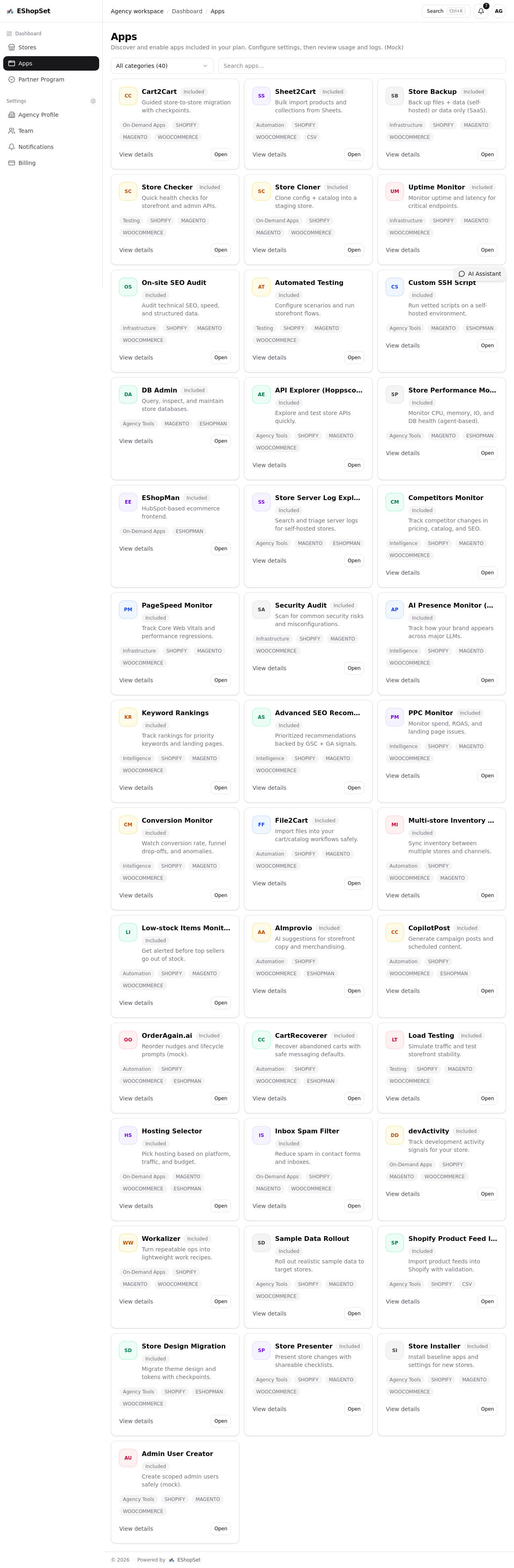
The challenges of multi-store product data and inventory management are precisely why we built EShopSet. Relying on manual updates or hoping for the best is a recipe for operational chaos. We strongly believe that leveraging dedicated apps from a central marketplace to manage your catalog and sync inventory across platforms like Shopify, WooCommerce, or BigCommerce is the only sustainable way to scale. Our platform allows you to discover, enable, and configure these crucial integrations, providing the robust "integrations-tools" you need to ensure accurate data and seamless operations, all tracked from one control center.
Ultimately, managing your ecommerce operations across multiple storefronts doesn't have to be a constant struggle. With the right strategy and the right apps, you can ensure your product data is accurate, your inventory is always in sync, and your customers have a consistent, positive experience no matter which of your stores they visit.
Keep those stores humming!